Tuesday, January 15, 2013

January 15, 1936: The Boston Bruins buy Flash Follett for $16,000


On January 15, 1936, Conn Smythe the owner of Toronto Maple Leafs sold William "Flash" Follett to the Boston Bruins for $16,000 at the time it was one of the highest amounts of  money a team had ever given for a player, by today's standards it would be over $250,000. It would be a decision Smythe would come to regret.

Hollett was a two sport player in fact he was discovered by Smythe while playing lacrosse. Smythe persuaded him to try his hand at professional hockey and inked him to a deal. His first few years on the ice were spent in the minor leagues, then in the '33-'34 season the Maple Leafs loaned him to the Ottawa Senators where he spent his first full season in the league. He returned to play for Toronto the following season and played another full year in the league before returning to the minors for a couple of seasons.

When Toronto sold him to the Bruins it would be a turning point in his career. He couldn't have landed with the team at a better time as the Bruins of the 30's were a dominate bunch that had too many future Hall of Famers to list. I would bet that fellow defenseman Eddie Shore had a good amount of influence on Hollett. He earned the nickname "Flash" becasue he was quick on the ice and he used that speed to become one of the best scoring defenseman in the NHL. His defining moment as a player came in Game 5 of the 1939 Stanley Cup Finals, Hollett scored the game winning goal that brought Boston their second championship in franchise history. The series had been played against the Maple Leafs which is why Conn Smythe might have regretted letting the player go.

Flash went onto help the Bruins grab another Stanley Cup championship in '41 and also became the top scoring defenseman in the league, in the '41-42 season he scored 19 goals tying the record for a defenseman, he then followed that season up with another 19 goal performance. Boston traded Flash Hollett to the Detroit Red Wings in the middle of the '44 season, he continued to put the biscuit in the basket. The year he was traded he scored 15 goals between the Boston and Detroit, the last 6 of those goals were in a Red Wings uniform. His first full year in Detroit he became the first defenseman in the league to score 20 goals, it was a record that until the '68-'69 season when Bobby Orr of Boston Bruins scored 21, it should be noted that when Hollett scored 20 goals he did it with just a 50 game schedule by the time it was broken the NHL had expanded to 76 regular season games. His numbers fell off drastically following the 20 goal season and after a contract dispute with Detroit GM Jack Adams he was traded to the New York Rangers. Hollett chose to retire instead of accept the trade to New York.

At the time of his retirement his 132 goals and 181 assists made him the highest scoring defenseman in the league with 313 total points. It was a pretty damn good career for a guy who had been sold for $16 grand a little more than a decade before. Flash Follett was a hard guy to dig up information on, most things I came across were short bits about how he should be in the Hall of Fame and I think those who say that have a great case. He was great player in his time and even if he played in an era that had many of his peers at war it shouldn't diminish what he did on the ice. I think with the fact that he won two Stanley Cup championships and retired as the top scoring defenseman in league history makes him among the league's best.

https://www.facebook.com/OnThisDayInSports

Monday, January 14, 2013

January 14, 1973: The Miami Dolphins Achieve Perfection


On January 14, 1973, the Miami Dolphins completed perfection as they beat the Washington Redskins 14-7 in Super Bowl VII. Miami was just one year removed from a humiliating 24-3 loss to the Cowboys in Super Bowl VI and many thought it was going to be tough to bounce back from that defeat. They didn't only bounce back, they achieved something that had never been done and hasn't been done since. The road to perfection didn't come easy, in the fifth game of the year starting quarterback Bob Griese broke his leg, this might have crushed most teams but this team was destined for greatness. Journeyman quarterback Earl Morrall did a great job filling in for the injured Griese. It helped that he had a three headed monster of a running game behind him with Jim Kiick, Larry Csonka, and Mercury Morris in the backfield they were a force to be reckoned with, in fact Morris and Csonka both crossed the thousand yard mark on the season making them the first teammates to both rush for 1,000 yards in a single season. After Morrall took over the Dolphins rang off 9 consecutive wins to finish the season a perfect 14-0

Even with the undefeated season there was still work to do if they wanted to redeem themselves from the Super Bowl loss one year earlier. Leading up to the big game they had two hurdles in front of them. The first hurdle was the Cleveland Browns in the AFC divisional round. The Dolphins just got by the Browns after scoring late in the fourth quarter gave them a 20-14 lead, they held on and were on the way to the AFC Championship game. The next hurdle was the Pittsburgh Steelers and it was another closely fought battle that would see Bob Griese return to the Dolphins lineup for the first time since week 5. Griese and his teammates proved to be the better team that day as they went onto win 21-17, punching their ticket to the Super Bowl.

Despite their undefeated record the Dolphins walked into the big game as 3 point underdogs against the Redskins. The underdog role didn't scare the Don Shula coached Miami team. Right out of the gate it was a defensive battle with both teams having to punt in their first two possessions of the game. After getting the ball at their own 37 with just 2:55 left on the clock, Griese walked his team down the field on a 63 yard drive that was capped off with a 28 yard touchdown reception by Howard Twilley. With just one second left in the first Miami had a 7-0 lead. Just three plays into the next Redskins drive Billy Kilmer threw an interception that landed in the hands of Dolphins safety Jake Scott. At this point in the game it looks like frustration was prevalent on both sides, two drives for the Dolphins were killed by penalties with one of those penalties wiping a 47 yard touchdown off the board. When it looked like Billy Kilmer and the Skins were starting to get going Kilmer threw another pick this time it landed in Nick Buoniconti's hands at the Miami 41 yard line, the linebacker returned it 32 yards setting his team up at the Washington 27 yard line. This time the Dolphins would capitalize on the mistake. After two quick runs Griese hit tight end Jim Mandich for a 19 yard gain. Two plays later Jim Kiick slammed it though the Washington defensive line for a 1 yard touchdown. With the score 14-0 at the half the Dolphins were one half away from perfection.

The Dolphins defense had dominated the Dolphins in the first half limiting them to just 49 yards on the ground and 23 through the air. It looked like Washington's coach George Allen had made necessary adjustments early in the second half as the Redskins were able to put together a drive that put them in range for a 32 yard field goal, when kicker Curt Knight sailed the kick wide right which took the wind right out of the sails for Washington. Turnovers haunted both teams, a Miami drive came to an abrupt end with the team just 5 yard away from scoring Griese threw a pick in the endzone. Then early in the fourth Billy Kilmer and the Skins put together a 79 yard drive that put the team at the Miami ten yard line, on a crucial third down play Jake Scott hauled in his second pick of the game, once again Billy Kilmer had shot himself in the foot. The Dolphins quickly moved the ball to the 34 yard line before staling out, Don Shula then decided to send out his kicker Garo Yepremian to attempt a 42 yard field goal. Yepremian's kick was too low and was blocked by Washington defensive tackle Bill Brundridge, Yepremian got to the ball and instead of falling on it he tried to pass the ball only to have it knocked into the air and right into the hands of Redskins cornerback Mike Bass who took it to the house. With only 2:07 left on the clock the 49 yard interception return looked like it gave the Skins new life but surprisingly they didn't go for the onside, instead choosing to kick deep. Washington had to exhaust all of their timeouts in the 5 plays that Miami held the ball before punting it back to them. With just a 1:14 left on the clock, Washington took over with a chance to tie. It just wasn't to be, Miami's "No Name Defense" stood tall knocking down two passes then causing Washington to lose yards on another passing play. With the game on the line defensive end Vern Den Herder sacked Kilmer on fourth down and the undefeated season went into the record books.

It was a game that was won in large part due to the efforts of the famous "No Name Defense" that Miami put out on the field. Defensive lineman Manny Fernandez led the Dolphins with 11 tackles and Jake Scott's two interceptions led the safety to being named Super Bowl MVP. In fact both teams struggled with getting it going in the passing game Griese went 8/11 for 88 yards while his counterpart Kilmer went 14/28 for 104 yards through the air. Kilmer's three interceptions really hurt his team's effort. In the running game Csonka led the Dolphins with 112 yards on the ground and on the Redskins side Larry Brown rushed for 72 yards. It really was a defensive battle that was finished off by Miami.

I have always heard the stories about the guys from that '72 team getting together and raising a glass after the last undefeated NFL team loses a game. Some of those stories might be slightly exaggerated but if they do I don't blame them a bit. In 2007, the New England Patriots came close to being in the same class as those '72 Dolphins after they completed a 16-0 regular season they advanced all the way to the Super Bowl before being knocked out by the New York Giants. By no means am I taking away anything from that unbelievable season for New England but there is only one truly undefeated team in the history of the NFL and they sealed their place in history on this day.

This is a great highlight reel:
http://www.youtube.com/watch?v=hKeZimoIr68

Here is a link to Yepremian's  play it would become known as "Garo's gaffe":
http://www.youtube.com/watch?v=NGC-uGKivvE

https://www.facebook.com/OnThisDayInSports

Sunday, January 13, 2013

January 13, 1968: Bill Masterson suffers an injury that would end his life


On January 13, 1968, at the Met Center in Minnesota, Bill Masterson of the North Stars suffered a head injury that would prove to be fatal. Just four minutes into the contest against the Oakland Seals, the 29 year old Masterson completed a pass to his teammate Wayne Connelly, he was then checked by Oakland's Ron Cahan and Ron Harris. The hit caused Masterson to fall backwards and hit his head on the ice. He had suffered a massive brain hemorrhage. Just two days later he passed away. Masterson is the only player to die because of injuries directly related to an NHL hockey game.

Masterson, a Winnipeg native went onto become a star player at the University of Denver where he lead the Pioneers to championships in 1958, 1960, and 1961. After graduating from college he was signed by the Montreal Candiens. He never did get a shot in Montreal because the team had so much depth. He spent several years playing minor league hockey before deciding to take a job with the Honeywell Corporation, a manufacturer of civil and military avionics and other aerospace products. In 1967, the NHL doubled in size and the expansion North Stars gave him a shot to achieve his lifelong dream of playing professional hockey. He made an instant impact on October 11, 1967, Masterson scored the first goal in the history of the North Stars franchise. Masterson would only play in 38 games before it all came to an abrupt end for the promising young player. Since his death no other player has worn his #19 for the North Stars, in 1987 the team retired it permanently just six years before they moved to Dallas.

Following the '67-'68 season the NHL started giving out the Bill Masterson Memorial Trophy, the award is given to a player that displays perseverance, sportsmanship, and true dedication to the sport of hockey which were all qualities of Bill Masterson. He persevered by achieving his dream, by all accounts he was a better person than a player and while his dedication to the game might have cost him his life he died doing something he loved. The award is often given to a player that overcomes a serious injury or illness and is able to return to the game successfully. Any player that receives the award should be sure and know that the name on it belongs to a man that literally gave his life to play the game that they all know and love.

Masterson's death led to widespread lobbying for players to wear helmets. It wouldn't be until the 1979-'80 season that it became mandatory for players to wear helmets, any player that played before that season had the right to choose whether to wear one or not. When I look up facts for On This Day In Sports I very rarely go with anything that involves the death of a player. In this case I didn't know the story of Bill Masterson, I had heard of the trophy but never knew the story of the man. I almost chose not to use this fact but I looked at his historical impact on the game and thought, while it is a very dark moment in pro sports, it can also be a way to remember the man. It wasn't only hockey who lost Masterson, he was a young father who I'm sure was loved by many.

Here is a great video that tells the story of Bill Masterson:
http://www.youtube.com/watch?v=dh_uLi6Bf7s

Here is a link to an archive of the St. Paul Dispatch immediately following his death:
http://www.northstarshockey.com/clip1.htm

https://www.facebook.com/OnThisDayInSports

Saturday, January 12, 2013

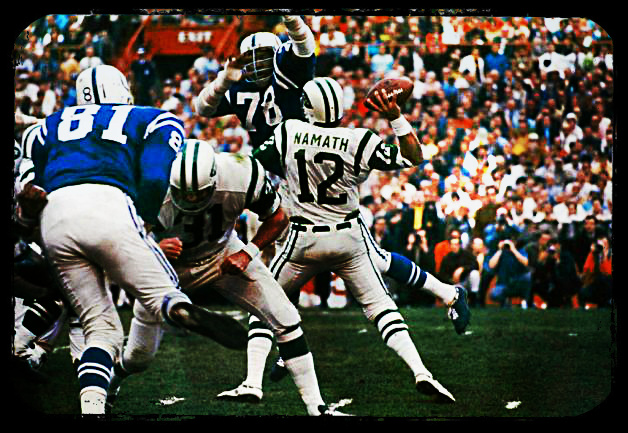
January 12, 1969: Joe Namath and the Jets upset the Colts in Super Bowl III


On January 12, 1969, star quarterback Joe Namath backed up his guarantee, as he led his Jets to a surprising victory in Super Bowl III. Just three days before the game was set to take place in Miami, Namath told reporters "We're gonna win, I guarantee it." It was a statement that would be immortalized after the Jets pulled off the improbable upset over the heavily favored Baltimore Colts. When Namath's head coach Weeb Ewbanks heard that his young star said that, he was beside himself  telling Joe you don't need to give that team anything to help motivate them. Joe came back with if they need that to motivate them they probably aren't going to win the game anyway. It's safe to say Namath's cup runneth over when it came to confidence.

Even with the guarantee almost everyone outside of New York thought the Colts would easily handle the 18 point underdogs, they were in for a surprise. The Jets came out in the first quarter and established their running game early, while they didn't score in the first quarter they were laying out groundwork for success. With Johnny Unitas sidelined due to injury the Colts started Earl Morrall at quarterback, early on it looked like he would lead the team well, they reached the Jets 19 yard line before kicker Lou Michaels missed a chip shot 27 yard field goal. That took the wind right of the Colts sails. Every time Baltimore had something go their way, they would shoot themselves in the foot. It was one thing after another, whether it be a missed field goal or Earl Morrall or throwing interceptions Baltimore was almost beating themselves. In the meantime, Namtath led his team on an 80 yard drive that was capped off with a four yard touchdown run by fullback Matt Snell. With the Jets up 7-0 it was the first time in Super Bowl History that an AFL team had led in a game.

The second half started off with a Colts fumble, which led to a three more points for the Jets. Baltimore was still lacking rhythm and were quickly forced to punt. Namath and his squad made the most of it by moving the ball 40 yards, to setup another Jim Tuner field goal. By the middle of the third quarter an exasperated Don Shula went to his injured quarterback Johnny Unitas. Initially Unitas didn't provide the spark Shula was looking for. He quickly went three and out which forced another Baltimore punt. Following the punt the Jets were able to hit another field goal early in the fourth quarter. With the score 16-0 it looked like it was over for Baltimore. Johnny U was able to engineer a drive that finally put 7 points on the board for the Colts, but it wouldn't be enough as the Jets hung onto the 16-7 victory. As Namath ran off the field he held up his index finger to signify his team was #1, and they were on that January day in 1969.

Namath went 17/28 with 206 passing yards, 133 of those yards went to receiver George Sauer. Broadway Joe received MVP honors for his performance, to this day Namath is the only quaterback to win the Super Bowl MVP without throwing a touchdown pass. While Joe was named the most valuable player his head coach Weeb Ewbanks was probably the most valuable member of the Jets organization. The game plan that Ewbanks put in place is what won the game for New York. With his #1 wide receiver Don Maynard hampered by injury, Ewbanks still used him as an effective decoy. With the Colts unaware of Maynard's injury they double teamed him which opened up the door for a big day for George Sauer. What makes this game so great is not only was it the first time that an AFL team won the Super Bowl, it was  like David slaying Goliath, nobody gave the Jets a chance besides those guys in the New York locker room, they knew they could and they showed the world what they were made of.

Friday, January 11, 2013

January 11, 1973: The Designated Hitter rule becomes a part of the American League


On January 11, 1973, the owners in Major League Baseball voted to allow American league teams to use a designated hitter, it would change the game. The rule allowed a designated hitter to bat for the pitcher while allowing the pitcher to stay in the game. The idea for the DH can be traced back to Connie Mack in 1906. It was said that Mack got tired of watching his pitchers swing senselessly at balls like they had no idea what they were doing at the plate. In 1928, National League President John Heydler brought up the idea once again, only to have the American League reject the idea. While it might have been talked about after that, it never came to fruition until one of baseball's biggest showmen Charlie Finley brought it up in the early 70's. This time it would gain traction and the wheels were in motion for the biggest change in baseball rules since 1903, when it was decided that foul balls would be considered strikes.


The meeting that took place on that January day had Charlie O. as the biggest proponent for the rule change,  he was by far one of the most colorful owners to ever be a part of the game and was always pushing for something new. A good portion of his ideas never seen the light of day but this one was different, initially the National League resisted the idea but gave in. It was originally supposed to be a three year trial run that became a permanent part of the game that we still see today. The first designated hitter in the history of baseball was Ron Blomberg of the New York Yankees. He was walked by Luis Tiant of the Boston Red Sox on Opening Day in 1973. There have been a number of great designated hitters since that day, names like Frank Thomas, Edgar Martinez, and "Big Papi" David Ortiz have taken on the role and had great success swinging the stick.

I was born and raised in St. Louis so I've always followed National League Baseball and it's safe to say I love my hometown Cardinals. I have always heard the National League side of the argument with people saying that the DH shouldn't be a part of the game. I tend to disagree with them, I believe it adds something unique to both leagues and it also helps some of the great hitters extend their careers, so I would consider myself a fan of the rule. With that said, I hope the National League stays away from making it a unilateral rule so we can keep the uniqueness it adds to the two leagues. One thing I would love to see is MLB flip flop the rule when it comes to interleague play. I think it would be great for the fans at a National League ballpark see teams have the designated hitter in the lineup and  the fans at the American League ballparks see the pitcher bat. That would show each fan base how it changes the strategic part of the game. I know that some love the rule and others hate it , I look at like it is part of the game and for me I like it.

https://www.facebook.com/OnThisDayInSports

Thursday, January 10, 2013

January 10, 1982: The Freezer Bowl


On January 10, 1982, the San Diego Chargers traveled to Cincinnati, Ohio to take on the Bengals in the AFC Championship game. The game would become known as "The Freezer Bowl", with temperatures dipping to -9 degrees it was only the second coldest game on record to the "Ice Bowl" that was played in Green bay in 1967 where the temperatures hit -15. Even though the temperature was technically colder in the "Ice Bowl" there were 25-30 mile per hour winds in Cincy in 1982 that made it feel temp was 51 below zero. Bengals head coach Forrest Gregg had played in the '67 Championship game on the Packers offensive line and he insisted it was colder in Cincinnati that frigid January day.


The game came just one week after the Bengals squeaked by the Bills with a 28-21 victory and the Chargers had just played the Dolphins in an overtime battle that became known as "The Epic in Miami". the game in Miami was an overtime thriller that was played in heat and humidity, very different than what the two teams were facing on this January day.
(Read about The Epic in Miami Here) http://onthisdayinsports.blogspot.com/2013/01/january-2-1982-afc-divisional-matchup.html

Before the Chargers even took the field running back Hank Bauer ran out to see how it felt and he described it as being hit with a 100 knives, they still had a game to play. Before it even started Forrest Gregg told his Bengals team "Look at this game like going to the dentist. It's going to hurt." When the Cincinnati
offensive line stepped on the field they did so without anything covering their arms, Bengals guard Dave Lapham recalled that the Chargers team looked at them like they might be mentally ill. The Bengals started off the scoring with a 31 yard field goal off the foot of Jim Breech. On the ensuing kickoff Chargers running back James Brooks fumbled the return and the Bengals snatched it up. Bengals quarterback Ken Anderson made the most of the opportunity and threw a quick strike to tight end M.L. Harris, extending the Bengals lead to 10-0. In the second quarter Chargers signal caller Dan Fouts was able to get his team on the board by hooking up with Kellen Winslow on a short pass that the tight end turned in to a 33 yard touchdown. The Chargers momentum swing was brief, the next time Fouts had the ball he was picked off by Bengals defensive back Louis Breeden. The pick turned into points for Cincinnati after they got to the goal line, running back Pete Johnson punched it in. The teams went into the locker rooms at the half with the Bengals hanging onto a 17-7 lead.

In the second half the Bengals put the Chargers away. Jim Breech kicked another field goal in the third quarter then in the fourth Ken Anderson nailed the coffin shut when he hit wideout Don Bass for a three yard touchdown. The final score was 27-7 and the Bengals were headed to their first Super Bowl in the history of the franchise. Some said that the difference from "The Epic in Miami" to "The Freezer Bowl" could have been a 150 degree swing in temperature, insane. The Bengals would lose to the San Francisco 49ers in the Super Bowl, but they had definitely earned respect by winning one of the coldest games to ever take place. It really goes both ways, the Chargers might have lost to the Bengals but they had come off a memorable game just the week before and I'm sure they gave everything they had that frigid day, only one team could win. It was a truly memorable game that I'm sure the 46,000+ in attendance will never forget.


You can watch a great old highlight reel here
http://www.youtube.com/watch?v=sWUMv9m76eY

https://www.facebook.com/OnThisDayInSports

Wednesday, January 9, 2013

January 9, 1993: The Detroit Pistons retire Bob Lanier's #16


On January 9, 1993, the Detroit Pistons retired Bob Lanier's number 16. After an outstanding college career at St. Bonaventure, Lanier was drafted #1 overall pick by Detroit in 1970. He quickly became a force in the league. By the end of his first season he was selected to the NBA all rookie team. The 6' 11" center brought excitement to the Detroit Pistons and they saw an instant rise in attendance. Following his rookie season Lanier scored more than 2,000 points and was named to his first all star game. In the '73-'74 season he helped lead Detroit to the playoffs where they were knocked out by the Chicago Bulls in the Western Conference Semi Finals in 7 games. While the team reached the playoffs for three more seasons following that run, they never did get passed the semi final round. Early in the '79-'80 season the Pistons were struggling under the new head coach Dick Vitale. Lanier could see that his time in Detroit might be coming to an end and by mid season he asked to be traded. The General Manager of the team then dealt him to the Milwaukee Bucks for Kent Benson and a first round pick. When he packed his bag to leave Detroit he said "I asked for that trade but my blood and guts were Pistons", I'm sure it was a tough thing to leave the team he had been a part of for so long. Lanier holds the Pistons record for average points per game with 22.3, his 8,063 rebounds are second in the team's history, and his 15,488 in a Detroit uniform ranks third in franchise history.


Lanier was a solid player in Milwaukee as well, in his 5 years with the Bucks he helped them win 5 Division Championships but wasn't able to reach The NBA Finals. He did come close with his team reaching the Eastern Conference Finals in his last two years in the league but could never get over that hump. When he retired in 1984 he had scored 19,248 points and also grabbed 9,698 rebounds. It was a remarkable 14 year career that led Lanier to not only having his number retired by the Pistons and the Bucks he also found himself as a member of the Naismith Basketball Hall of Fame. If you visit Basketball's Hall of Fame in Massachusetts  you can compare your foot to the massive skis that Lanier wore, his size 22's were inducted before the player was.

Lanier is one of the players that had a great career but never won the title and it pained him greatly. The year he retired he said in an interview with the Milwaukee Sentinel "I accomplished most of the individual goals I could ever dream of in the game". He went onto say "But the ultimate reward is to be crowned champions. And if you don't know what that feel is, I think it leaves a void." I'm sure that void is something that stays with a player throughout their lifetime, even though it is there, it does not take away from their accomplishments for me. Lanier was a great player that the Pistons, Bucks and the entire basketball community made sure to immortalize his name.

https://www.facebook.com/OnThisDayInSports